Day 38: Reed Whittemore, Joy Williams, Dwight Macdonald
Poem: Reed Whittemore - The Party
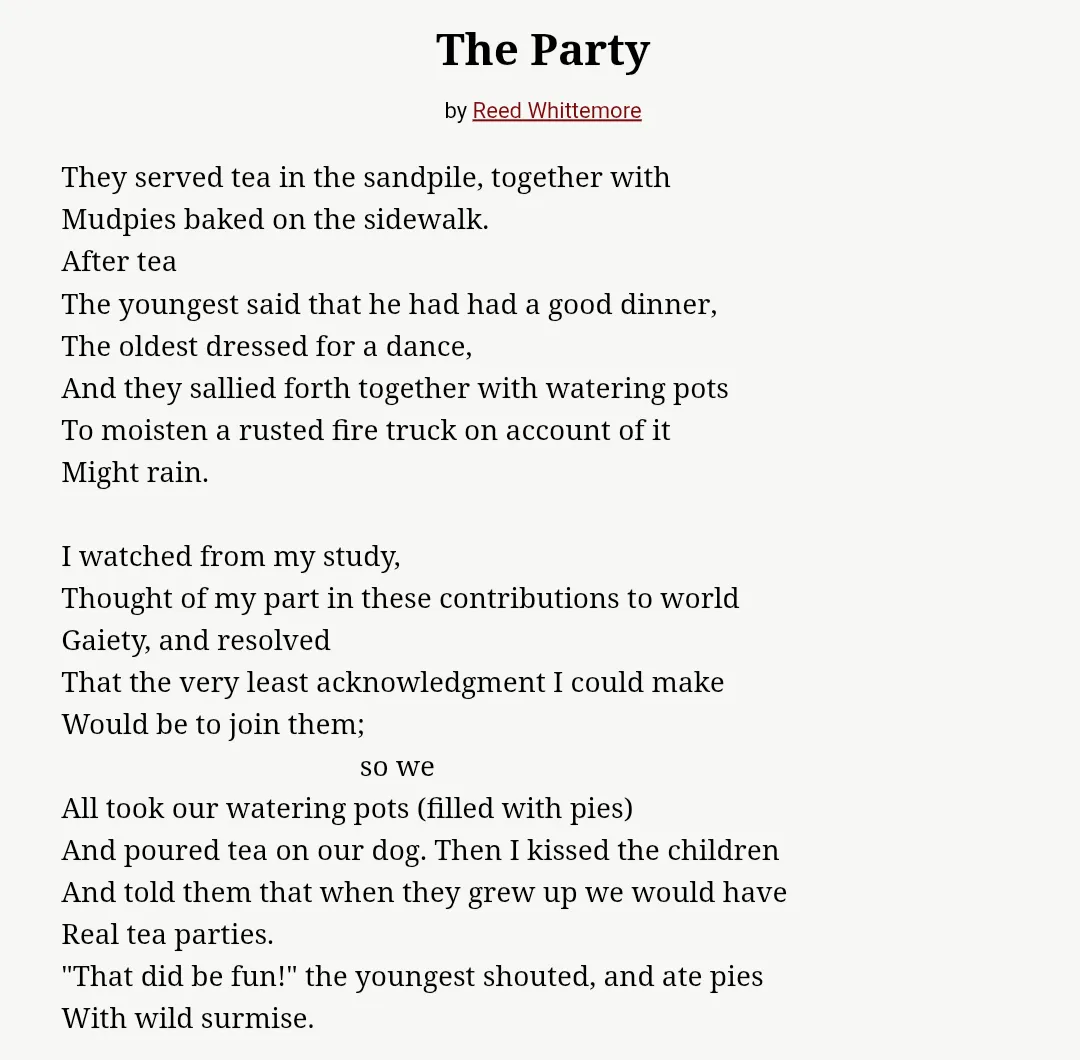
I am going to be cheerful and sentimental here, because however impaled my heart, I still have a beaming Holden Caulfield-like love for children and small things.
I love how vivid and accurate this feels. The small details such as filling the watering can with mud or pouring water on the rusty firetruck with practical intent feels so true to real life. I have a 3 year old nephew, and a lot of our play outdoors in the last couple years has felt like this.
I love that the narrator, a father, is observing from his study, writing this poem perhaps, and then decides he will contribute to "world gaiety" by acknowledging their world. It is so joyful. The line breaks between world and gaeity felt really profound to me, and the big breath of space before "so we" is wonderful as it precedes the run-on silliness that follows.
What feels most poignant is the line ".. told them that when they grew up we would have / Real tea parties. / "That did be fun"...
I know for a fact that real tea parties and romantic dinners and christmas lunches are never so free and fun as the 2year old's tea party. So I think this poet really captures a fleeting moment in his children's life, knowing that they will soon learn sense and grammar. But the least he can do is play along with them in that moment.
A cool poem.
Story: Joy Williams - Flour
I really don't get this one, but I didn't get half her stories in 99 Stories of God and still enjoyed that immensely. It is both specific and vague, mystical and dreamlike. Part of the problem is I expect this story to have a clear meaning or point or plot - but it is quite uncertain.
A woman is going on a 3 day car trip with her driver who has three rows of backseats. Is it a mini-bus or a limosine? And why is it filled with all her belongings and two dogs. She never specifies why they are moving, and it is implied she is coming home. So it is a road trip story where we learn mostly about her driver.
In a strange detail, the driver is studying the ancient language of Coptic and is translating a bible story into the language. The story is the Parable of the Broken Jar, which Wikipedia says goes:
The kingdom of the father is like a certain woman who was carrying a jar full of meal. While she was walking on the road, still some distance from home, the handle of the jar broke and the meal emptied out behind her on the road. She did not realize it; she had noticed no accident. When she reached her house, she set the jar down and found it empty.
This broken jar of flour is the central motif to the story which is somewhat puzzling at this moment.
Anyway, the woman doesnt care about the driver's enthusiasm for his hobby. She appears to not care about anything.
There is this really great and revealing couple paragraphs in the middle which show Williams as a great noticer and master of parataxis:
We are at a crossroads light behind a new, bright yellow truck. When the light changes the truck accelerates, and a dense cloud of black smoke erupts from the tailpipe. People spend more than $1,000 to customise their vehicles for this effect, which honours freedom and individuality. It takes a moment for the simple clarity of the air and sky to reassert itself.
When a little baby dies you think, if they can do it with such wonderment, so can I.
The bright yellow truck, the yolk-coloured truck, dances away. He is not going in our direction...
How about that. The line about her dead baby placed in between the humorous description of a coal-roller. Yowza!
Then there are several scenes that follow the conventions of road-storiess. Dodgy hotels, various sceneries, and the bonding between the mismatched buddies (yet despite the driver's attempts to befriend her, she remains icy to him).
At the end they arrive but we don't know where. She says with surprise that the place is utterly foreign, but he says that the place is much the same as always.
So is the whole story like the empty jar parable? You think you are carrying the story somewhere but when you reach the end you find it is empty?
Says the driver about the empty jar: "What is important is the quality of the emptiness she eventually discovers, and that is what is so difficult to suggest."
I guess this story reminds me a lot of Joan Didion's nihilistic novel Play It As It Lays.
Goes thr famous line: "I know what nothing means and keep on playing".
Dwight Macdonald - Ernest Hemingway
We read Old Man and the Sea for bookclub and I was struck how philosophically vapid it was. Hemingway speaks of achievement like some profound truth but it is all the cliches of manhood you've heard in every movie. Kitsch, Greenberg would call it. I felt quite bad in slagging off this book at the book club, considering I'd just listened to the audiobook so was perhaps just responding to the certain way it was read. Maybe if I had read it as a book, I could have bathed in Hemingway's famous prose.
But this critic Dwight Macdonald (the most American name I've heard in a while) backs me up on the Hemingway disappointment. He spends this article dismantling, no, destroying the legacy of Hemingway and not in a reactionary "woke" way but in a way that criticises the lazy simplicity of his content and form.
You will have to just read the essay to see just how well Macdonald writes and how many convincing arguments he makes. Macdonald's prose is brilliant- possibly because he might be styling himself after Hemingway or parodying him. I still like Hemingway's prose.
What I find amazing about the book version of the essay (In Masscult and Midcult) is that Macdonald attaches a several-page rebuttal from George Plimpton who basically argues against every claim Macdonald has made. The rebuttal starts with:
Well dammit, Dwight, let's start off with his smile. I don't think Hemmingway smiled a smile that was "uneasy around the edges." It was a big smile, his shoulders shook when he laughed, and he showed his teeth. If he sometimes had a startled look on his face in the photos, that was because of the flash bulbs, which hurt his eyes and gave him fierce headaches.
The rest of it is really fun and funny to read, especially in Macdonald's footnotes where ge acts like an indignant child recieving a stern telling-off.
It is some of the most exciting criticism I have read with its boldness and brashness. Hell yeah.